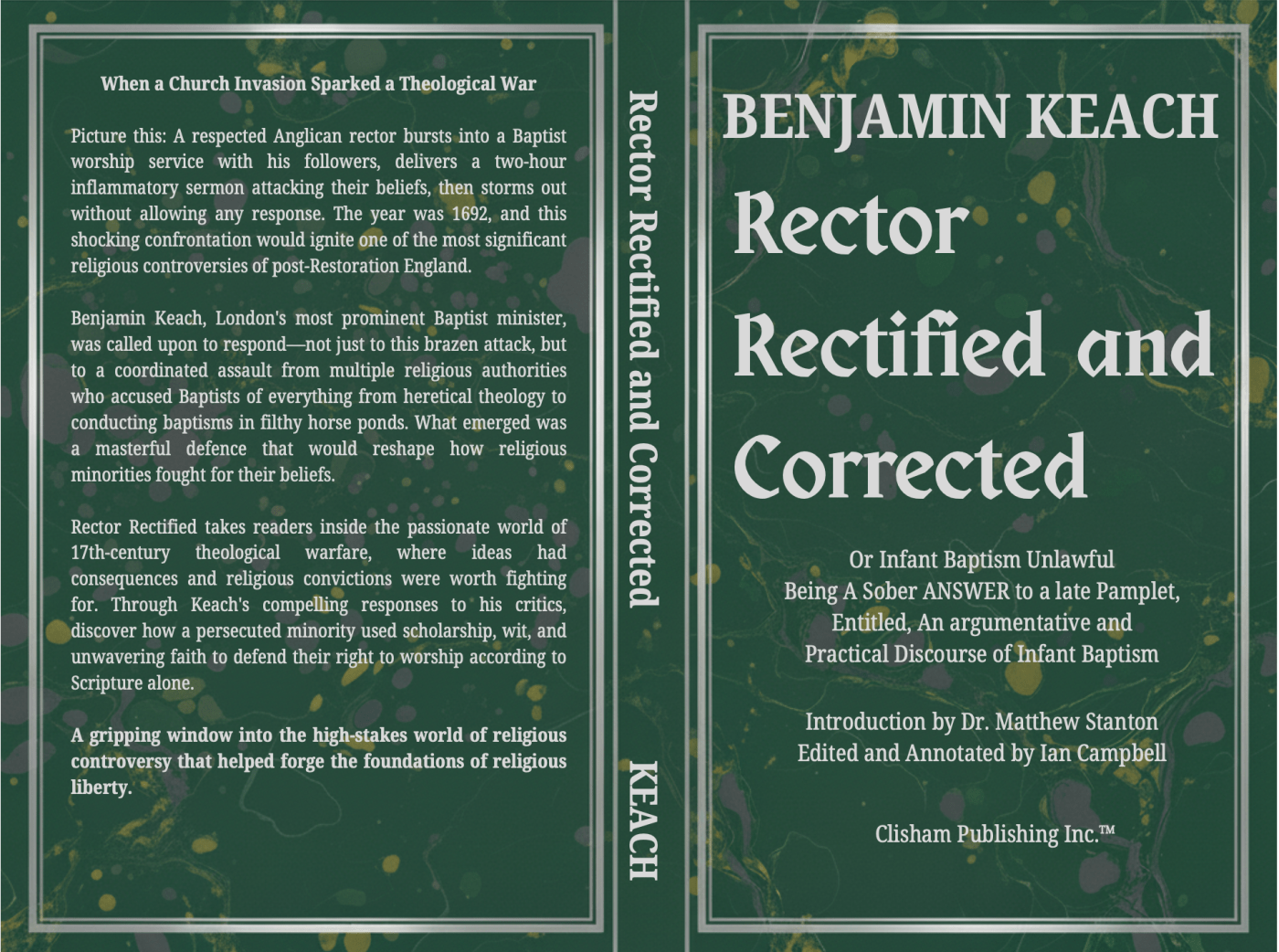
Clisham Publishing is pleased to be releasing the works of Benjamin Keach! This reader friendly series will include every work that he produced! The first release is Keach’s Rector Rectified.
Benjamin Keach’s Rector Rectified (1692) is an excellent example of the type of theological debates taking place in late 17th century London. The work demonstrates Keach’s polemic work in the print media. The topic at hand was infant baptism. As a Calvinistic Baptist, suffused in that community, Keach argued that infant baptism, as a practice, was not in accordance with the prescriptions of Scripture. Many of his fellow ministers in London, however, were not of like mind. There were many, particularly those in the established – Anglican Church, that believed that infant baptism (paedobaptism) was a right and proper sacrament of the church. They held that the age of the individual being baptised was inconsequential since baptism was a matter of faith and commitment to the community on behalf of the parents. Given the high infant death rate, this baptism was their seal of faith assuring parents that their child, should they pass, would meet them in Heaven.
Given the intimate context associated with the practice, this theological debate was highly contested. To make matters worse for Keach, there were far more Anglican churches in London than Baptist congregations.[1] But Keach was not bothered. The text discusses the historical arguments surrounding infant baptism, particularly focusing on the rebuttals against a Mr. William Burkit (1650-1703). Burkit was the rector of Mildin (Milden – modern spelling) in Suffolk, 90 miles northeast of Keach’s location. Burkit’s first, and most influential publications, was An argumentative and practical discourse of infant-baptism (1692).[2] This work continued in print into the 1720s.[3] He was an educated minister having entered Pembroke Hall, Cambridge, graduating with a BA in 1668 and MA in 1672.
The work itself begins with John Tredwell’s “Epistle to William Burkit”. Tredwell was a minister in Kittle-Baston (Kettlebaston – modern spelling), Suffolk. In this epistle, Tredwell defends himself against Burkit’s accusations regarding his baptizing some folk in a “Horse-pond, into which the Filth of the adjacent Stable occasionally flows, and that the People baptized in the said Pond, came forth with much Mud and Filthiness upon them”.[4] Tredwell claims that this statement recorded in Burkit’s aforementioned work was untrue and unfounded. Tredwell is then supported by a certification of record, which Keach also includes in this work, signed by five Baptist ministers and six ‘non-Baptists’ alike. It appears that Keach included both the epistle and subsequent certification to lay the groundwork for his own arguments: that Burkit was indeed a rector who needed to be rectified in his claims about and regarding infant baptism.
In Keach’s “Epistle to the Reader”, he begins by calling for unity and love among believers despite their differing views on infant baptism. While he highlights the importance of adhering to scriptural truths in baptism practices, it is apparent that the nature and tone of the debate was of concern to him.[5] Having addressed the tone of the debate, Keach begins to lay out his own arguments. Keach’s main arguments against infant baptism are outlined as follows:
- that the covenant of circumcision is not equivalent to the Gospel covenant.
- that baptism should only be administered to those who profess faith.
- that the scriptural support for infant baptism is ambiguous at best.
- that the early church never meant for infant baptism to be the normative practice in the church.
Central to Keach’s arguments for credobaptism is his theological understanding of covenant. Having contrasted the roles of circumcision and baptism in the context of the covenants, Keach argues that circumcision was described as a sign of the covenant made with Abraham, but not a seal of the covenant of grace. In that way, baptism is presented as a positive law that requires explicit divine command for its administration. And since Keach found no such positive command for the method of infant baptism in Scripture, he determined it be unnecessary. He instead asks Burkit, and all of similar leanings, to return to scriptural foundations rather than relying on human traditions or interpretations.
Perhaps the one paedobaptist argument that Keach seems to sympathise with most is the baptising of dying infants. Keach acknowledges that their baptism attempts to demonstrate their proper admission to Heaven. However, as he suggests, since it is God’s grace that is extended to these little ones offering eternal rest, the waters are nothing more than a symbol. For Keach, and the Particular Baptists at large, baptism was always meant to be more than a symbol of faith. Baptism was – and is – understood to be the proclamation of faith before God and in the presence of the community of faith.
While the old covenant, including infant membership, has been abolished, the new covenant is presented as a spiritual house built on faith, where only believers are admitted. While the old covenant provided earthly promises, the Gospel offers spiritual blessings and eternal life. The privileges under the Gospel focus on regeneration and the indwelling of the Holy Spirit. And just as the church in the new covenant does not include infant church membership, as it is based on personal faith and understanding, so should they not baptise infants into the membership. Further, faith and repentance are prerequisites for baptism, therefore, infants cannot be disciples as they lack the capacity for understanding and faith. Baptism does not inherently change a person’s nature or guarantee salvation. As Burkit argued, baptism alone can regenerate an individual. But for Keach, true regeneration and faith must precede baptism for it to be meaningful.
Regarding the mode, Keach argued that sprinkling or the pouring of water did not constitute true baptism, which should involve full immersion. He asserted that the Greek word “baptizo” means to dip or immerse, not to sprinkle. Further, Keach demonstrates that the historical practices of baptism reveal that immersion was the norm in early Christianity, making “the modern practice of sprinkling” as a deviation from the original intent of baptism. This deviation had many negative connotations to Keach. First, that many baptized infants grow up without true faith, leading to a false sense of security. Secondly, that this practice may contribute to a broader societal issue of perjury and spiritual neglect. Thirdly, Keach voices concern that the church’s integrity is at stake as it is always compromised whenever the acceptance of unbiblical practice becomes normalized.
Baptism is a crucial sacrament in Christianity, symbolizing the death, burial, and resurrection of Christ, and the believer’s commitment to a new life in Him. Baptism represents the believer’s identification with Christ’s death and resurrection. It is seen as a necessary act of obedience and a public declaration of faith. Keach roots the significance of baptism in scriptural references, including his exegesis of Romans 6:3-4. Therefore, this was not a matter of theological preference; baptism was a matter of divine importance and central to baptistic identity.
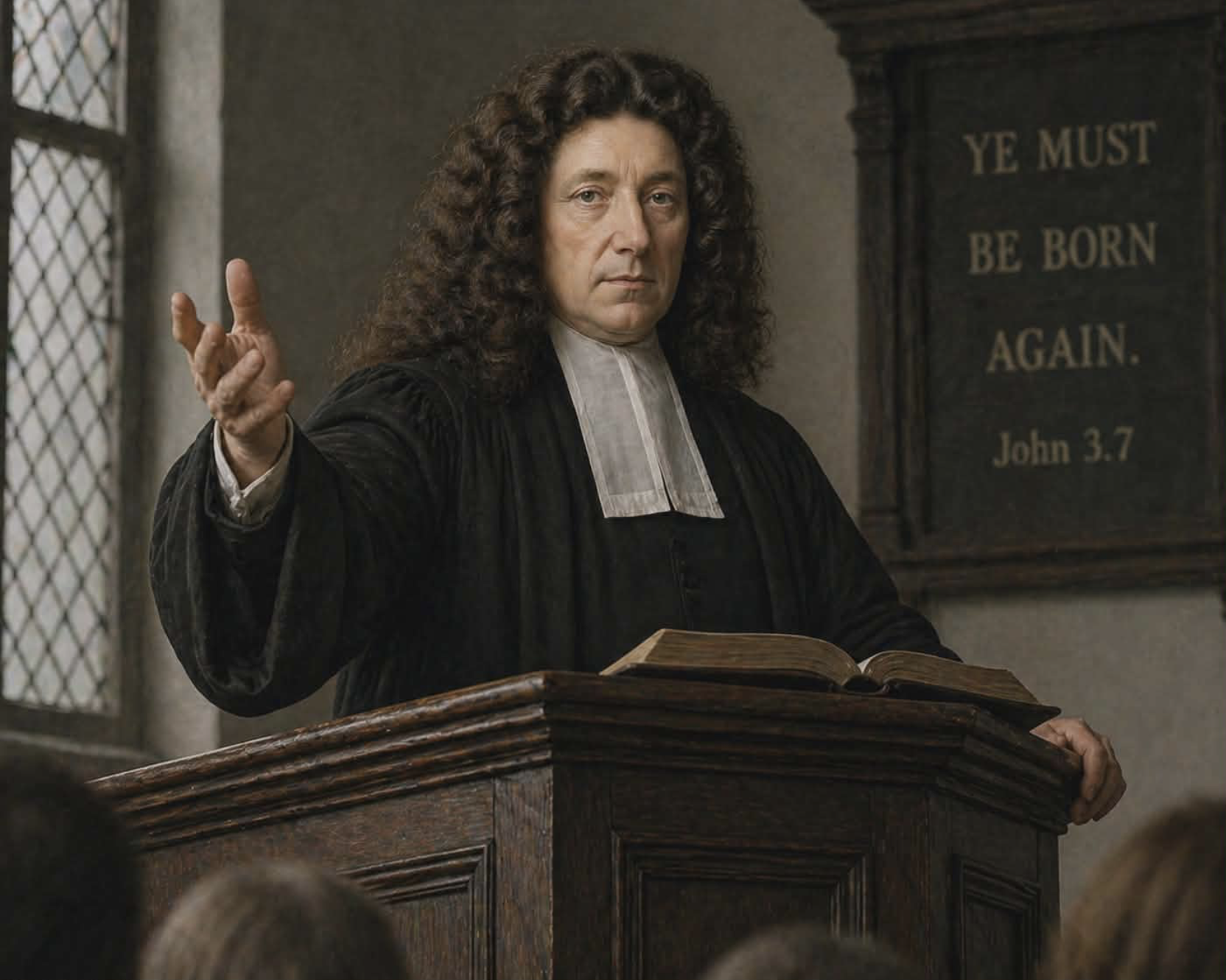
To make matter worse, another parallel debate was unfolding alongside this episode between Keach and Burkit. The Athenian Society’s role in furthering this controversy is evident through their publications of the time. The Athenian Society’s publications contributed to the debates surrounding infant baptism as Keach engaged them after they failed to adequately address his queries on infant baptism. They responded to Keach’s challenges by deeming them insufficient, which in turn prompted further discourse. Keach was essentially taking on an entire faction represented in the church in England at the time. Rector Rectified then should be understood and read not as a polemical work between two ministers, but a work in defense of the emerging Baptist denomination against the backdrop of the established church. It is a story of David versus Goliath, only there were 100 Goliaths at Keach’s door. Unashamed of his convictions, and clear in his articulation, Keach was ready to rectify the dismal state of baptism as practiced by the established church. For Keach, and Particular Baptists at large, this was a matter of conviction.[6]
[1] There were likely over 100 Anglican churches in the greater London area by 1700, while only 107 Particular Baptist churches were inexistence in the whole of England, including Wales.
[2] William Burkit, An argumentative and practical discourse of infant-baptism in which I. The lawfulness of infant-baptism is demonstrated, II. The objections against infant-baptism are answered, III. The usefulness of the ordinance is asserted, IV. The sinfulness of re-baptizing manifested, V. The non-necessity of dipping evidenced, VI. The practical use of infant-baptism urged and inforced, (London: Printed by T.M. for Thomas Parkhurst, 1692).
[3] Editions include the 1692, 1695, 1702, 1712, and 1722.
[4] John Tredwell, “Epistle to William Burkit”, in Benjamin Keach, Rector Rectified (London: 1692), introductory epistle.
[5] Keach’s concern over tone was perhaps due to another significant debate that he was involved in: the hymn-singing. In that debate, many harsh words were written and tempers flared. Keach, having learned from these interactions just two years prior, sought to approach this debate with proper quorum.
[6] For more on this debate, see: Austin Walker, The Baptismal Controversy of the 1690s and its Relevance for Today, (Macclesfield, UK: Broken Wharfe 2024).


Leave a Reply